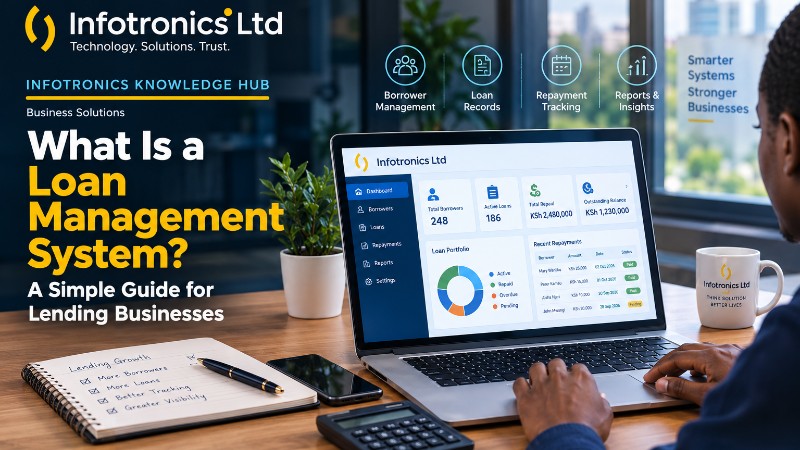
What Is a Loan Management System? A Simple Guide for Lending Businesses
Infotronics Knowledge Hub
Infotronics Business Solutions
Helping you make smarter technology decisions.
What Is a Loan Management System? A Simple Guide for Lending Businesses
Reading Time: 9–11 Minutes
Last Updated: October 2026
Quick Answer
A Loan Management System is a digital system that helps a lending organisation manage loan-related information and processes in an organised way.
Depending on the system, it can help with areas such as:
- Borrower records
- Loan information
- Repayment tracking
- Outstanding balances
- Transaction records
- Reporting
- Operational follow-up
For a lending business, the goal is simple:
Make loan information easier to record, track, review and manage.
This can be particularly useful as the number of borrowers, loans and repayments grows.
Why Loan Management Becomes Difficult as a Business Grows
A lending business can start very simply.
A borrower is registered.
A loan is issued.
The repayment is recorded.
The balance is updated.
At the beginning, this may be manageable using notebooks, spreadsheets or individual files.
Then the business grows.
There are more borrowers.
More loans are active at the same time.
Repayments happen on different dates.
Some borrowers pay in instalments.
Some loans become overdue.
Staff members need to access records.
Management needs reports.
Suddenly, keeping everything accurate becomes much harder.
The problem is no longer simply:
"Where did we write this down?"
It becomes:
"Do we have an accurate picture of what is happening across the entire loan portfolio?"
That is where a digital loan management system can become valuable.
What Is a Loan Management System?
A Loan Management System is software designed to help organise the information and operational processes associated with lending.
Instead of keeping borrower information, loan details and repayment records in separate locations, a digital system can bring relevant information together.
The exact capabilities differ from one solution to another.
However, a good system should help a lending organisation answer questions such as:
- Who has an active loan?
- How much was issued?
- How much has been repaid?
- What balance remains?
- When was the latest payment made?
- Which loans need attention?
- What is the overall state of the portfolio?
The real value isn't simply replacing paper.
It's creating structured and connected information.
Manual Loan Records vs Digital Loan Management
Manual records can still work for a very small lending operation.
A notebook or spreadsheet may be enough when there are only a few borrowers and transactions.
As the business grows, however, the amount of information increases.
| Area | Manual Records | Digital Loan Management |
|---|---|---|
| Borrower records | Manually maintained | Centrally organised |
| Loan records | Separate entries/files | Digital records |
| Repayments | Manually recorded | Recorded within the system |
| Balance tracking | Often calculated manually | Can be managed digitally |
| Searching | Can take time | Searchable records |
| Reporting | Often prepared manually | Reports can be generated |
| Record history | Can be fragmented | Easier to review in one place |
| Growing portfolio | Increasing administrative work | Better suited to structured scaling |
The exact functionality depends on the system being used.
? At a Glance
| If your business needs... | A digital system can help by... |
|---|---|
| Organised borrower information | Keeping records in a structured environment |
| Better loan tracking | Connecting loan information to borrower records |
| Repayment visibility | Keeping payment information easier to review |
| Balance monitoring | Maintaining more structured loan information |
| Reporting | Turning recorded information into reports |
| Easier record retrieval | Allowing users to search digital records |
| Better operational visibility | Bringing related information together |
What Information Does a Lending Business Need to Manage?
A loan doesn't exist in isolation.
There is a relationship between the borrower, the loan and the payments associated with it.
A lending organisation may need to keep track of:
Borrower Information
Who is the borrower?
How can the organisation identify and contact them?
Loan Information
What amount was issued?
When was it issued?
What is the loan status?
Repayment Information
What has been paid?
When was it paid?
How much remains?
Portfolio Information
How many active loans exist?
How much money is outstanding?
Which accounts need attention?
A digital system can make these relationships easier to manage.
? Think of It as a Connected Record
Imagine a borrower called James.
James receives a loan.
That loan becomes part of his record.
He later makes a repayment.
That payment becomes part of the same financial history.
Another payment follows.
The outstanding balance changes.
Instead of keeping each event in a separate notebook, a digital system can maintain the information as part of a connected record.
That is one of the biggest advantages of moving from fragmented records to a digital system.
? Infotronics Expert Tip
Before choosing loan-management software, don't start by asking:
"How many features does it have?"
Start with:
"Can it give me a clear picture of each borrower's position and the overall state of the business?"
Clarity is often more valuable than a long feature list.
Why Repayment Tracking Matters
Issuing a loan is only the beginning.
The lending business also needs to know what happens afterward.
Repayments need to be recorded consistently.
Balances need to be followed.
Outstanding amounts need to remain visible.
Management may also need to know which accounts are up to date and which require attention.
When this information is maintained manually, even a small error can create confusion.
A digital approach can make repayment information easier to organise and review.
?? Tech in Practice
A Growing Lending Business
Imagine a small lending organisation that starts with 30 active borrowers.
The team knows most customers personally.
Repayments are recorded in a spreadsheet.
At that stage, the process may seem manageable.
A year later, the business has several hundred active borrowers.
Now there are:
- More loans
- More repayment transactions
- More outstanding balances
- More staff
- More records to search
- More management questions
The same spreadsheet-based process that worked initially may now become difficult to maintain.
The business hasn't necessarily changed its basic activity.
The volume of information has changed.
That's where structured digital management becomes much more valuable.
Why Searchable Records Matter
Imagine a customer calls and asks:
"How much do I still owe?"
If the information is stored across notebooks, spreadsheets and separate files, someone may need to search through several records.
With a well-organised digital system, authorised staff can retrieve the relevant information much more efficiently.
This matters not only for speed but also for the quality of customer service.
Reporting and Management Visibility
A lending business shouldn't operate entirely on individual loan records.
Management also needs the bigger picture.
For example:
- How many loans are currently active?
- How much has been issued?
- How much has been repaid?
- What remains outstanding?
- Which areas require attention?
- How is the portfolio changing over time?
Reporting brings individual records together into information that management can review.
This is where a loan management system moves beyond record keeping.
It becomes a management tool.
Why Data Accuracy Matters
Loan businesses deal with financial information.
That means accurate records are especially important.
A small mistake in a borrower record or repayment entry can affect balances and later decisions.
Digital systems can help structure the information, but technology alone doesn't guarantee accuracy.
The organisation still needs:
- Correct data entry
- Good procedures
- Proper user training
- Regular review
- Clear responsibilities
A good system supports good processes.
It doesn't replace them.
When Should a Lending Business Consider a Digital System?
There isn't a universal borrower count at which every organisation should move to software.
Instead, look at the signs.
A lending business may be ready when:
- There are many active borrowers.
- Staff spend too much time searching for records.
- Repayment tracking is becoming difficult.
- Balances are frequently recalculated manually.
- Management needs regular reports.
- Multiple employees handle loan records.
- The business is expanding.
- Management wants greater visibility into the loan portfolio.
The important question is:
"Is our current process still reliable as the business grows?"
Who Can Benefit From a Loan Management System?
Loan management technology can be relevant to different types of lending organisations.
For example:
Microfinance Organisations
Organisations managing multiple borrowers and loan accounts may benefit from more structured digital records.
SACCOs
As member and lending activity grows, organised digital information becomes increasingly useful.
Lending Businesses
Businesses issuing and collecting loans can use digital systems to manage the information associated with those operations.
Other Credit Providers
Any organisation with a recurring lending and repayment process may benefit from evaluating digital loan-management tools.
The suitability of any system depends on the organisation's actual workflow and requirements.
?? Common Mistakes
Mistake 1: Waiting Until Records Become Unmanageable
Many organisations only consider digital systems after their current process has already become difficult to control.
It is often better to evaluate the options before the problem becomes serious.
Mistake 2: Choosing Software Based Only on Price
A cheap system isn't necessarily good value.
Consider:
- What information it manages
- How easy it is to use
- Whether it supports your workflow
- Reporting capabilities
- Scalability
- Support
- Data management
Mistake 3: Assuming Software Automatically Prevents Errors
A digital system can improve structure and traceability, but inaccurate data can still produce inaccurate results.
Good processes remain essential.
Mistake 4: Ignoring User Training
The people entering and managing information need to understand the system.
Even good software can be poorly used if users aren't properly trained.
Mistake 5: Looking Only at Individual Loans
Management needs both views:
Individual borrower information
and
the overall portfolio.
A useful loan management system should support both operational work and management visibility.
What Should You Look for in a Loan Management System?
Before choosing a solution, think about the actual workflow of your organisation.
Borrower Management
Can the system organise borrower information clearly?
Loan Management
Can staff record and track loan information in a structured way?
Repayment Tracking
Can payment information be recorded and reviewed easily?
Reporting
Can management get the information needed to make decisions?
Search and Retrieval
Can authorised staff find records quickly?
Scalability
Can the system continue to work as the number of borrowers grows?
Usability
Can the people using the system every day work with it comfortably?
Support
Is there somewhere to turn when users need help?
Where Kopo Loan Management System Fits
For organisations looking for a digital solution specifically focused on loan management, Kopo Loan Management System is part of the Infotronics business-solutions portfolio.
The important starting point, however, is the same one we've discussed throughout this guide:
Understand the lending workflow first.
Then choose technology that supports that workflow.
Rather than selecting software simply because it has a long list of features, organisations should evaluate how well the solution fits their actual lending operations.
The right system should make loan management clearer, more organised and easier to follow.
We will expand this section with the verified Kopo Loan Management System capabilities once we use the official Kopo system documentation as our source.
? Infotronics Expert Tip
Draw your current process on one page:
Borrower → Loan → Repayment → Balance → Follow-Up → Report
Then identify where your team currently spends the most time or experiences the most difficulty.
That's often the best starting point for evaluating a digital solution.
? Before You Choose
Ask these questions:
? What information do we currently record?
? Where is that information stored?
? How easily can we retrieve a borrower's history?
? How are repayments tracked?
? How are outstanding balances reviewed?
? What reports does management need?
? How many people will use the system?
? How might our needs change as the business grows?
? What support will we need after implementation?
These questions can help you compare solutions based on your real requirements rather than marketing claims.
? Did You Know?
The biggest challenge in lending isn't simply issuing loans.
It's maintaining a clear and accurate picture of what happens after the loan is issued.
Repayments, balances, follow-up and reporting all depend on reliable information.
That's why structured loan management becomes increasingly important as a lending business grows.
Frequently Asked Questions
What is a Loan Management System?
It is a digital system used to organise and manage loan-related information and processes such as borrower records, loan records, repayments, balances and reporting.
Who needs a Loan Management System?
It can be useful for organisations that manage loans and repayments, including lending businesses, microfinance organisations, SACCOs and other credit providers.
Can a Loan Management System track repayments?
Many loan-management systems provide repayment tracking, although the exact functionality depends on the particular solution.
Can a Loan Management System manage borrower records?
Yes, borrower management is a common part of loan-management software, although the fields and capabilities vary between systems.
Why are digital loan records useful?
Digital records can make information easier to organise, search, review and report on compared with fragmented manual records.
Does a Loan Management System eliminate human errors?
No. It can help improve consistency and structure, but accurate data entry, proper processes and user training are still essential.
When should a small lending business move to a digital system?
There is no universal threshold. Consider moving when the volume of borrowers, loans or repayments makes the existing manual process difficult to manage reliably.
Is a Loan Management System the same as accounting software?
Not necessarily. A loan management system focuses on lending-related processes, while accounting software focuses primarily on financial accounting. Some organisations use both.
What should I consider before choosing one?
Consider your lending workflow, borrower records, repayment tracking, reporting needs, number of users, scalability, ease of use and support requirements.
The Infotronics Verdict
If your lending operation is growing and manual records are becoming difficult to manage, a digital loan management system may be worth considering.
Don't choose software simply because it has the most features. Choose a system that makes your lending workflow easier to understand and manage.
The right solution should help your team organise borrower information, track loan activity, maintain clearer records and give management better visibility.
As the lending business grows, the system managing it should grow with it.
Final Thoughts
A lending business runs on information.
Who borrowed?
How much was issued?
What has been repaid?
What remains outstanding?
Which records need attention?
Without organised information, answering these questions can become increasingly difficult.
Manual records can be a reasonable starting point, but growing organisations often need a more structured approach.
A Loan Management System provides a way to bring important lending information into a digital environment and make it easier to manage.
The goal isn't simply to replace notebooks or spreadsheets.
The goal is to create clearer information, better organisation and stronger operational visibility.
Good loan management starts with good information.
Need Help Choosing?
Not sure whether your lending business is ready for a Loan Management System?
The Infotronics team can help you understand the options and think through the technology requirements that fit your organisation's lending workflow.
Whether you're managing a growing lending business, SACCO or microfinance operation, we're here to help you make a practical technology decision.
Call or WhatsApp: 0756 398 449
Email: sales@infotronics.co.ke
Continue Learning
Explore more from the Infotronics Knowledge Hub:
- What Is a POS System and How Does It Work?
- Manual Stock Management vs POS Systems: Which Is Better for a Growing Business?
- What Is a Healthcare Management System?
- How to Choose the Right Laptop for Your Needs in 2026
- How Much RAM Do You Really Need in 2026?
- How to Improve Wi-Fi at Home or in the Office in 2026
About the Infotronics Knowledge Hub
The Infotronics Knowledge Hub is designed to make technology and digital business solutions easier to understand.
Our guides cover technology products, business systems, networking, cybersecurity, healthcare management systems and other practical technology topics to help individuals and organisations make better-informed decisions.
Whether you're choosing a device, improving a business process or exploring a digital solution, our goal is simple:
Help you make smarter technology decisions.